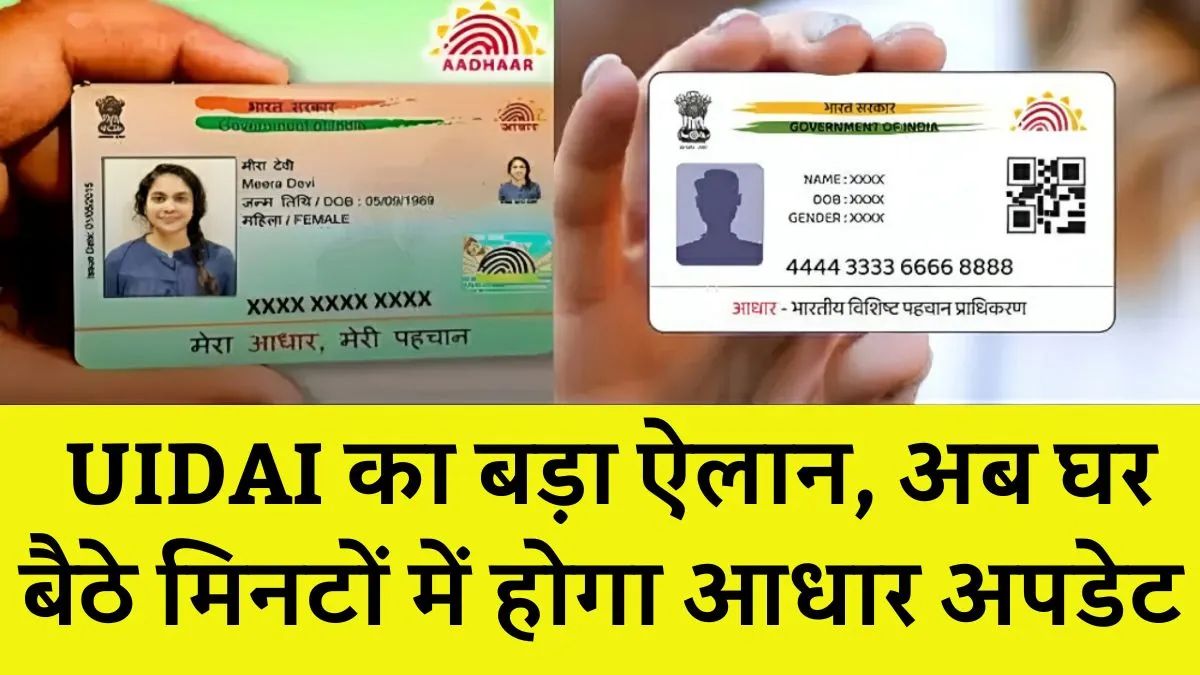
If you’ve ever stood in a long queue just to update your Aadhaar card, you know how exhausting that feels. The waiting, the forms, the endless visits to centres — it’s something most of us have been through. But here’s the good news: from November 1, 2025, the Unique Identification Authority of India (UIDAI) is changing the way Aadhaar updates work. This time, things will be different — simpler, faster, and completely online.
Why These Aadhaar Changes Matter More Than You Think
Aadhaar has become more than just an identity card — it’s linked to everything important in your life. From opening a bank account to filing taxes or applying for government schemes, you need it everywhere. But for years, even a small mistake in Aadhaar meant endless paperwork and centre visits. UIDAI is finally fixing that.
Starting November 1, you’ll be able to update key details like your name, address, date of birth, or mobile number without stepping out of your house. Everything will be done digitally, and your documents will now be automatically verified through official databases like your PAN, passport, driving licence, or ration card. The idea is to make the process as smooth and safe as possible.
Major Changes Coming from November 1, 2025
Here’s the thing — this isn’t just a small tweak. UIDAI is introducing a full system overhaul. Earlier, you had to visit an Aadhaar Seva Kendra even for a basic address change. Now, the new process removes that dependency completely. The system will automatically verify your details with connected government records.
This means you no longer need to worry about standing in queues or waiting for weeks. Everything will happen within days, all online. And since verification is being handled through secure databases, the process becomes both faster and safer.
H2: Aadhaar-PAN Linking Now Compulsory
There’s another major update — UIDAI has made Aadhaar-PAN linking mandatory. You must link your PAN card with Aadhaar by December 31, 2025. If you don’t, your PAN will become inactive from January 1, 2026. This rule applies not just to existing PAN holders but also to new applicants. Anyone applying for a PAN card will need to verify their Aadhaar first.
This move is meant to reduce fraud and ensure that all financial records are properly linked to a verified identity. It’s one more step toward a transparent and digital India.
New Aadhaar Update Fees — What You’ll Pay
UIDAI has also introduced a new fee structure for updates. The goal is to keep it fair and transparent so that people know exactly what they’re paying for. Updating basic details like name, address, or mobile number will now cost ₹75, while updating fingerprints, iris, or photo will cost ₹125.
For children between the ages of five and seven, and again at fifteen to seventeen, biometric updates will remain completely free. Online document updates are free until June 14, 2026, after which they’ll cost ₹75. If you need a printed Aadhaar copy, it’ll cost ₹40. And if you choose home enrolment services, you’ll pay ₹700 for the first person and ₹350 for each additional person at the same address.
The message is clear — UIDAI wants every citizen to have easy access to Aadhaar services without hidden charges or middlemen.
KYC Process Becomes Faster and Simpler
We’ve all experienced the pain of doing KYC — multiple documents, long delays, repeated verification. UIDAI is now changing that too. The KYC process will become simpler, faster, and more digital.
Now, financial institutions can complete KYC through Aadhaar OTP, video KYC, or direct face verification. It means you’ll be able to open a bank account or apply for financial services right from your phone, without ever visiting a branch.
This is a big leap toward a fully digital India, where everything — from identity to verification — happens securely online.
H2: How to Update Aadhaar Online from Home
The process is designed to be simple and stress-free. You just have to visit the official UIDAI website at uidai.gov.in, go to the “My Aadhaar” section, and click on “Update Your Aadhaar.” Log in using your Aadhaar number and OTP. Then select the field you want to update — whether it’s your address, mobile number, or any other detail. Upload the necessary document, submit your request, and you’re done.
Within a few days, your Aadhaar will be updated. No queues, no waiting, and no centre visits. Just you, your phone, and a few clicks.
H3: Common Questions People Are Askin
1. Can I still update my Aadhaar offline after November 1?
Yes, the old offline method will still exist, but the online process is quicker and easier.
2. What if I don’t link my PAN with Aadhaar?
Your PAN card will become inactive after January 1, 2026, if not linked by December 31, 2025.
3. Do I need to give biometrics again?
Only if you’re updating your photo or fingerprints. For simple updates like address or mobile, no biometrics are needed.
4. When should I update my child’s Aadhaar?
Biometric updates are required at ages 5, 7, and 15 — and they’re completely free.
5. Will documents still be needed for online updates?
Yes, but UIDAI will automatically verify them through government databases, so the process will be much faster.